
Reading list · 8 books, ranked
The Best Books for Nurse Practitioner Students
As an RN moving into graduate nursing education, you face a fundamental shift in how you think about patients. Instead of supporting a provider's diagnosis, you now own that responsibility. This reading list focuses on the intellectual and professional tools you'll need to make that transition: clinical reasoning, diagnostic thinking, the identity shift from clinician to decision-maker, and the knowledge foundations that support independent practice.
Updated 2026-07-13
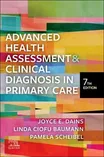
Advanced Health Assessment & Clinical Diagnosis in Primary Care
Joyce E. Dains, Linda Ciofu Baumann, Pamela Scheibel · 2003
This textbook reorganizes patient assessment around symptoms rather than anatomy. Instead of examining systems independently, you learn to take a complaint (chest pain, cough, fatigue) and walk through the history and physical exam findings that point toward specific diagnoses. The authors model the diagnostic reasoning process at every step, showing how experienced clinicians narrow the differential and reach a working diagnosis.
This book teaches you the core competency that distinguishes NP practice from nursing: moving from 'what do I see?' to 'what is wrong with this patient?' It's where the intellectual transition begins, and it's the foundation every NP program builds on.
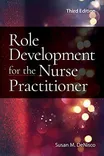
Role Development for the Nurse Practitioner
Susan M. DeNisco, Julie G. Stewart · 2013
This book directly addresses what it means to become a nurse practitioner: how your professional identity shifts, what competencies define advanced practice, and how you navigate the new relationships with collaborators, employers, and patients. It uses real stories from practicing NPs to illustrate the transition and includes assignments and case examples for reflection.
The identity shift from RN to provider is not automatic, and many students struggle with imposter syndrome or role confusion. This book legitimizes the transition and helps you understand what you're actually becoming, not just what you're studying.
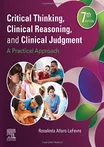
Critical Thinking, Clinical Reasoning, and Clinical Judgment
Rosalinda Alfaro-LeFevre · 2013
Rather than teaching you specific diagnoses, this book teaches you HOW to think clinically. It breaks down the reasoning process into steps, shows how to generate and test hypotheses, and addresses the common thinking errors that lead to misdiagnosis. The author works through real patient scenarios to model clinical judgment in action.
NP education gives you facts and guidelines, but this book teaches you the thinking process that connects them. It's the bridge between memorizing symptoms and actually reasoning your way to a diagnosis under the pressure of real clinical work.
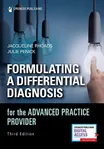
Formulating a Differential Diagnosis for the Advanced Practice Provider
Jacqueline Rhoads, Julie C. Penick · 2022
This workbook presents 95 symptom-based patient cases with step-by-step diagnostic reasoning. Each case starts with a chief complaint, builds through history and findings, and shows how to systematically eliminate possibilities and arrive at a diagnosis. The reasoning is laid out explicitly so you can see the thinking process, not just the answer.
Practice builds competence. These cases take the frameworks from other books and put them into realistic scenarios where you work through differential diagnoses the way you'll do it in practice. Many NP students use this book throughout their clinical rotations.
Bates' Nursing Guide to Physical Examination and History Taking
Beth Hogan-Quigley, Mary Louise Palm, Lynn S. Bickley · 2012
This is the Bates guide adapted specifically for nurses. It teaches how to conduct a complete history and physical exam, but frames it for advanced practice: how to ask pertinent questions, recognize key findings, and know when you need to dig deeper. The text includes normal and abnormal findings organized by body system.
As an RN, you know how to do a head-to-toe assessment. As an NP, you need to conduct a focused, hypothesis-driven exam. This book bridges that gap and shows you how to gather the clinical data that supports (or refutes) your diagnostic thinking.
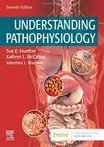
Understanding Pathophysiology
Sue E. Huether, Kathryn L. McCance · 2019
This textbook explains disease mechanisms at the cellular and system level: how inflammation happens, why hypertension damages organs, what happens in heart failure. It's not a list of facts to memorize but an explanation of WHY patients present with certain symptoms and what their physical findings mean.
Clinical reasoning requires understanding the biology behind what you observe. When you know pathophysiology, you stop recognizing patterns and start understanding causation, which makes you a better diagnostician and helps you remember what matters.
Clinical Case Studies for the Family Nurse Practitioner
Leslie Neal-Boylan · 2011
Over 70 patient cases ranging from neonatal to geriatric care, presented in SOAP format (Subjective, Objective, Assessment, Plan). Each case includes the patient history, physical exam findings, and relevant test results, followed by diagnostic and management options and critical thinking questions.
This book translates clinical reasoning into the format you'll use in practice. Working through these cases teaches you how to organize patient information, think through a differential, and document your thinking in a way that communicates with colleagues.
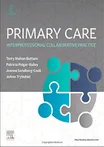
Primary Care: Interprofessional Collaborative Practice
Terry Mahan Buttaro, Patricia Polgar-Bailey, Joanne Sandberg-Cook, JoAnn Trybulski · 2020
This doorstop of a textbook covers the common conditions you'll see in primary care: hypertension, diabetes, respiratory infections, mental health concerns, and more. For each condition, it presents assessment, differential diagnosis, and management, but also emphasizes the evidence base, patient education, and how to work with other providers.
This book gives you the clinical knowledge base for independent NP practice. It goes beyond the 'how do I think' to 'what do I know' and 'what do I do about it.' It's reference material you'll return to throughout your career.
From the shelf to the field
Reading your way from RN to provider
The identity shift these books describe, from carrying out the plan to writing it, is the hard part of NP school that no pathophysiology course covers. The logistics are their own maze: program formats, clinical hour requirements, certification exams, and state scope-of-practice rules.
For that side of the transition, this guide to the nurse practitioner career path, from RN experience to independent practice lays out the requirements and pay you can sanity-check your plans against.
Where to go next
- compare NP programs · formats, costs, and clinical placement models
- how to become a nurse practitioner · the full RN-to-NP timeline
- is a DNP worth it? · the doctorate question, argued with numbers