
Reading list · 8 books, ranked
The Best Books for Robotics and Mechatronics Students
Whether you're building your first Arduino project or designing automated systems, these books bridge theory and hands-on work without the dry textbook treatment. You'll find practical projects, manufacturing stories, and the philosophy of making things yourself. Start with the builder's guides and let the classics anchor your understanding of how machines actually work.
Updated 2026-07-13
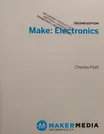
Make
Charles Platt · 2009
Learn electronics through practical experiments you build with your own hands, starting with circuits and components before diving into the theory behind them. The book covers everything from breadboards to oscillators, with hands-on projects including an alarm system, light effects, and an autonomous robot that senses obstacles. Each chapter is structured as a discovery where you build first and understand later.
This is the most direct path into electronics for someone who learns by tinkering rather than reading theory. The robot projects teach sensor integration and control loops in a way that sticks because you're holding the components while you learn.
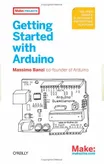
Getting Started with Arduino
Massimo Banzi · 2008
A practical introduction to the Arduino microcontroller platform written by one of its founders, showing how to move from simple LED circuits to interactive projects that sense and respond to the world. The book covers the fundamentals of physical computing, schematic reading, and how to write code that makes hardware move and respond. Projects include light-sensing systems, motion detection, and communication between Arduino and computers.
Arduino is the standard entry point for robotics students, and learning it from the creator's own guide means you understand the platform's philosophy and flexibility. You'll spend less time debugging setup issues and more time actually building.
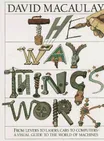
The Way Things Work
David Macaulay · 1988
A visually inventive exploration of machines and mechanical principles using playful illustrations (featuring woolly mammoths) to explain how levers, gears, pulleys, and complex devices actually function. From simple inclined planes to automatic transmissions and radio telescopes, the book reveals the underlying logic of mechanical design. The newest edition updates the original to cover digital technology and how screens and sensors work.
When you're deep in robotics, it's easy to lose sight of the basic mechanical principles that make everything possible. This book reminds you why gears matter and how simple ideas combine into sophisticated machines, all without requiring advanced math.
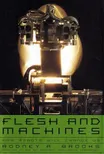
Robot
Rodney Allen Brooks · 2002
Written by MIT's legendary robotics researcher, this book traces the history of artificial intelligence and robotics while questioning what we really mean by intelligence and consciousness. Brooks shares stories from his MIT lab where his team built increasingly autonomous robots, exploring how simple reactive behaviors can create complex-seeming intelligence without trying to replicate the human brain. The narrative spans from early AI dreams to practical robots that actually work in the real world.
Understanding how a robotics pioneer thinks about problems gives you a mental toolkit you won't get from engineering handbooks. Brooks argues for simplicity and iteration, principles that are now fundamental to robotics work and the maker movement.
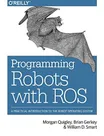
Programming Robots with ROS
Morgan Quigley · 2015
A practical guide to the Robot Operating System, the industry standard for robotics research and development, covering how to build autonomous systems by linking sensors, actuators, and decision-making software. The book teaches ROS concepts through working examples, showing how to handle sensor data, communicate between processes, and debug real robot behavior. It balances practical recipes with understanding why ROS's architecture works this way.
ROS is what professional robotics engineers actually use, and this book teaches it without assuming you already know it. If you plan to work in robotics beyond hobby projects, fluency with ROS becomes essential quickly.
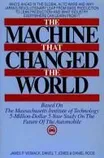
The Machine That Changed the World
James P. Womack · 1990
A groundbreaking study of how Toyota developed lean manufacturing and changed the global automotive industry through process innovation and continuous improvement. The book reveals how Toyota systematically eliminated waste, accelerated problem solving, and empowered workers to improve production, eventually overtaking General Motors in size and efficiency. It documents a revolution in how factories organize people, machines, and information.
Automation doesn't exist in a vacuum; understanding how industrial systems actually organize work, and how they can be optimized, gives you perspective on why robotics exists and what it's trying to solve. Many of robotics principles derive from these manufacturing innovations.
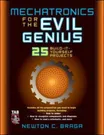
Mechatronics for the Evil Genius
Newton C. Braga · 2005
A collection of 25 build-it-yourself projects combining electronics, mechanics, and control including a robot arm, light-beam remote control, coin tosser, and autonomous cart that avoids obstacles. Each project includes a full parts list, circuit diagrams, and construction methods, teaching how sensors and motors work together in real devices. The projects range from simple to challenging, letting you build at your own pace.
Working through projects designed specifically to teach mechatronics concepts is faster than designing your own from scratch. These projects introduce patterns you'll see repeatedly in robotics work: sensor reading, decision logic, and motor control.
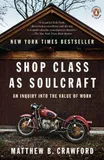
Shop Class as Soulcraft
Matthew B. Crawford · 2009
An essay on the value of working with your hands and tools, arguing that hands-on skills have been systematically devalued while abstract knowledge work is overvalued. Crawford draws on his own experience as an electrician and mechanic to explore why building, fixing, and making things provides intellectual satisfaction that office work often lacks. The book challenges the assumption that everyone should abandon technical work for knowledge careers.
Robotics and automation careers are built on the foundation of people who actually enjoy working with mechanical systems and tools. This book articulates why that work matters and why the problem-solving satisfactions of building tangible things are worth pursuing.
From the shelf to the field
Two doors into the same lab
Half these books are written by engineers, half by builders, and that split mirrors the field itself: mechatronics has a technician route (two-year programs, hands on the hardware) and an engineering route (four-year degrees, systems design), with real jobs and different pay behind each.
Compare mechatronics and robotics career paths, technician through engineer to see which door matches the way you like to work.
Where to go next
- robotics technician careers · hands on the hardware in two years
- the MSSC CPT-MT certification · the credential plants actually recognize
- controls engineering careers · the PLC side of the field