
Author guide
James Patterson
James Patterson built his reputation on narrative momentum. After leaving advertising in the 1970s, he published The Thomas Berryman Number, a debut thriller that won the Edgar Award. What set him apart was an ability to construct plots with relentless forward drive, the kind that makes readers lose track of time.
His 1993 introduction of Alex Cross, a Washington D.C. forensic psychologist turned detective, launched him into a different commercial stratosphere. At his peak, his books accounted for roughly 6 percent of all hardcover novels sold in America. By the early 2000s, Patterson recognized that he could conceive plots faster than any one person could write them. He hired collaborators, including Michael Ledwidge and Maxine Paetro, to handle prose while he shaped story architecture.
This division of labor generated multiple franchises: Alex Cross (30+ books), Women's Murder Club, Maximum Ride, Michael Bennett. Over 425 million copies sold worldwide. Patterson also funded teaching scholarships and literary awards. He demonstrated that commercial thriller writing could operate at industrial scale without apology or literary pretense.
Where to start, in order

Along Came a Spider
James Patterson · 1993
Washington DC detective and forensic psychologist Alex Cross is drawn into the investigation of two children kidnapped from an elite private school. As he works to recover them, he discovers the kidnapper has a personal vendetta and nothing is as it appears.
This book created Patterson's most durable character and established his trademark style: accessible prose, high stakes, and puzzle-like plotting. It turned him from regional bestseller into a national phenomenon and proved that thrillers built on detective work rather than action could command mainstream attention.

Kiss the Girls
James Patterson · 1995
Alex Cross's niece goes missing in North Carolina, and when he arrives to help find her, he uncovers a pattern of kidnappings spanning multiple states. A serial predator is hunting college-aged women, and Cross must enter the killer's psychology to stop him.
This sequel deepened Cross's character and introduced the psychological complexity Patterson excels at. It proved the Alex Cross concept could sustain a series without simply repeating the first book's plot, establishing the formula that would support 30+ novels.
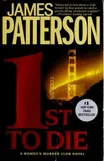
1st to Die
James Patterson · 2001
Four women in San Francisco form an unofficial task force: a homicide inspector, an assistant district attorney, a medical examiner, and a crime journalist. They track a killer targeting honeymoon couples, with each investigator bringing her own personal stakes and professional expertise to the hunt.
This book launched Patterson's second major franchise and proved his appeal wasn't tied to any single character. It showed he could generate compelling ensemble casts and weave multiple narrative strands without sacrificing momentum, establishing the Women's Murder Club as a viable standalone universe.
Pop Goes the Weasel
James Patterson · 1999
A powerful government figure's assassination sends shockwaves through Washington DC. Alex Cross investigates a conspiracy that reaches into the highest levels of power and forces him to confront institutional corruption.
By this point in the series, Patterson had refined his formula to maximum effectiveness: high-stakes victims, a killer who is showman as much as criminal, and Cross operating under pressure from multiple directions. It represents the Alex Cross series at peak power.

Suzanne's Diary for Nicholas
James Patterson · 2001
A woman discovers a diary belonging to someone named Suzanne, which reveals a story of love, sacrifice, and family tragedy. As the narrator reads, her own life begins to mirror the diary's events, creating layers of loss and connection across time.
This book shows Patterson's range beyond the thriller formula. It's quieter, character-centered, and emotionally driven, proving he could sustain reader interest without high body counts or action sequences. It demonstrates the range that made him a complete commercial fiction powerhouse.
The Thomas Berryman Number
James Patterson · 1976
A professional assassin is hired to kill a powerful political candidate and moves through a world of hired operators and political machinations, leaving a trail of bodies while operating according to his own moral code.
Patterson's debut won the Edgar Award and introduced the spare, efficient plotting style that would define his entire career. For readers who want to understand where his sensibility originated, before he became a commercial juggernaut, this shows the foundation of everything that followed.