
Author guide
Rick Moody
Rick Moody emerged in the early 1990s as one of American fiction's sharpest critics of suburban middle-class life. His novels and stories map the fragile structures that hold families and communities together, treating the collapse of these structures with unflinching attention to both the ridiculous and the tragic. Where other writers might sentimentalize decline, Moody renders it with precise, unsentimental prose that mirrors how consciousness actually works, jumping between time periods and perspectives.
His debut, The Ice Storm, became a cultural touchstone for its November 1973 portrait of dissolution in Connecticut. But Moody has never repeated that formula. Subsequent novels have grown more ambitious in form and scope, experiments in narrative structure and fragmentation that match their emotional intensity. He's worked in television and film, published a searching memoir that excavates personal history with the same rigor he brings to fiction, and consistently refused both commercial formulas and easy answers.
Awarded a Guggenheim Fellowship and named to The New Yorker's "20 Writers for the 21st Century" list in 1999, Moody occupies a rare position in American letters: a writer whose books matter to critics and readers alike, whose formal intelligence never overwhelms the emotional truth at the center of his work.
Where to start, in order
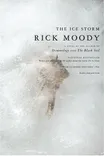
The Ice Storm
Rick Moody · 1994
Two neighboring families in a Connecticut suburb collide over Thanksgiving weekend 1973, their private disasters intersecting with the historical moment. Moody renders the era through precise material detail (wood paneling, failed marriages, the hum of television) while building toward a climax that feels both inevitable and inexplicable.
This is the novel that established Moody's vision and remains his most accessible entry point. It shows his ability to find genuine tragedy in ordinary suburban life, to balance formal sophistication with emotional clarity, and to make a single weekend feel like the arc of a whole civilization in decline.
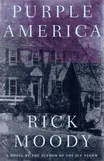
Purple America
Rick Moody · 1997
Spanning decades across a man's life, this novel follows Tolliver and his extended family through disjointed memories and narrative fragments. The structure moves backward and forward through time, revealing how accumulated small betrayals and disappointments congeal into something like spiritual death.
Where The Ice Storm proves Moody can capture a moment in perfect focus, Purple America demonstrates his ability to sustain formal complexity and emotional intensity across the full scope of a life. The novel is structurally bolder and thematically darker, establishing him as a writer unafraid of ambition.
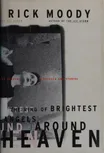
The Ring of Brightest Angels Around Heaven
Rick Moody · 1995
Moody's debut story collection introduces his compressed, dark-comic narratives and his gift for finding revelation in ordinary moments. The title story, which won the Paris Review's Aga Khan Award, traces an unexpected connection between two people whose lives briefly intersect.
This collection proves that Moody's gifts extend across forms. The stories are tightly constructed and devastating, each built on a single image or idea that opens outward to encompass something much larger. It establishes him as a master of the short form.
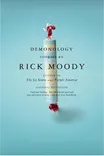
Demonology
Rick Moody · 2000
A collection built around interconnected narratives, Demonology explores how stories circulate through culture and create meaning. The famous title story, inspired by a real hoax haunting, demonstrates Moody's dark comedy and his fascination with how narrative itself can be seductive and dangerous.
By this point, Moody had fully refined his voice. The collection shows a writer unafraid of formal experimentation, capable of holding multiple tones simultaneously, and committed to remaining emotionally grounded even when exploring the most abstract aspects of storytelling.
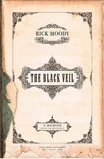
The Black Veil
Rick Moody · 2002
Moody's only major memoir weaves together his own struggle with depression and substance abuse with the biography of his ancestor Thomas Hooker, a Puritan minister. Rather than resolving the tension between these two narratives, the book lets them illuminate each other, treating the search for understanding as necessarily incomplete.
This work proves that Moody's preoccupations with history, mortality, and private anguish aren't limited to fiction. It's his most personal book and his most formally daring, showing how memoir and history can be woven into something that feels both intimate and universal.
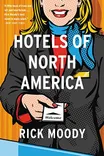
Hotels of North America
Rick Moody · 2015
Framed as a series of reviews written by a lonely traveling salesman, this novel catalogs hotel rooms and their amenities while actually mapping a man's emotional unraveling across years and geography. The conceit is simultaneously comic and heartbreaking, treating the mundane details of corporate hotels as sites of genuine human desperation.
This later work demonstrates that Moody's formal innovation and emotional depth have only deepened with time. The novel proves he remains a necessary voice in American fiction, capable of finding the profound in the banal and treating loneliness with both comedy and genuine compassion.